
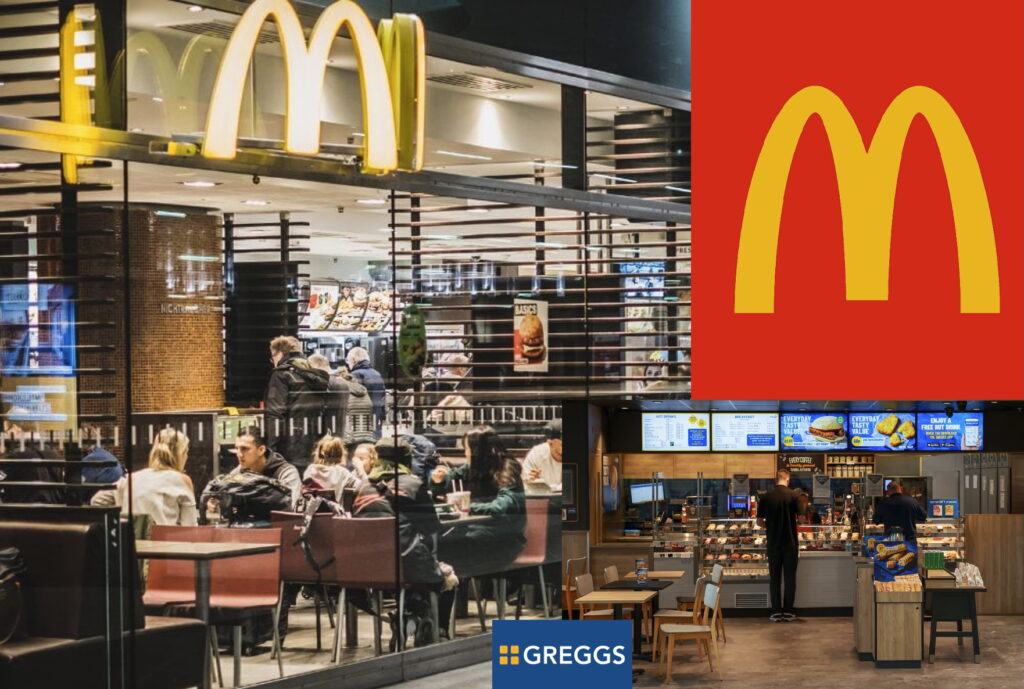
Key points
- Great investing begins with a simple question: what do people need to survive?
- Food is immune to economic cycles – people must eat.
- Not all food businesses are equal. Brand strength and financial performance determine quality.
- McDonald’s demonstrates how operational excellence, executed over decades, builds extraordinary shareholder value.
- At AXIAM, we invest in proven quality businesses. We buy them at fair valuations and hold them for the long-term.
Introduction
The quality of any investment portfolio is ultimately determined by the quality of the companies within it. At AXIAM, we define quality through two enduring characteristics: proven customer loyalty and financial strength. The best businesses are not simply profitable today — they are businesses that have proven profitable for decades. Our role as investors is to find those businesses, and to own them patiently.
To identify them, we start with a straightforward principle. We invest in companies that serve needs human beings cannot live without. Hydration, food, hygiene are not discretionary spending categories. Companies that supply these essentials will always have customers, regardless of the economic climate.
Food is compelling because every person on earth needs calories to survive. In our modern age, the way we source and consume food has evolved enormously, but the underlying need has not changed. This makes the food sector a natural hunting ground for quality businesses with durable, long-lived competitive advantages.
In this article, we compare two food service companies — McDonald’s and Greggs — to illustrate what distinguishes a great business from a merely good one, and why that distinction matters so profoundly for long-term investors.
McDonald’s
The McDonald Brothers’ pivot to food in 1937 was born of pragmatism. Having sold a struggling movie theatre battered by the Depression, they opened a simple hot dog stand near an airport. It was an immediate success — and it confirmed an insight that would shape their entire future: the food business is depression-proof. People must eat.
By 1948, the brothers had translated that insight into an operational revolution. At their San Bernardino, California location, they introduced the “Speedee Service System” — a radical departure from the slow, carhop-driven “drive-in” model that dominated the era.

Applying factory assembly-line principles to a commercial kitchen, they stripped the menu to a handful of core items, eliminated plates and silverware, and engineered efficiency into every transaction.
It was Ray Kroc, a milkshake machine salesman, who recognised the true potential of this model in 1954. Kroc saw not just a restaurant, but a replicable system — one that could be reproduced thousands of times with perfect consistency. He joined the company, eventually acquired it, and perfected the franchise model that would carry McDonald’s across the globe. McDonald’s did not invent fast food. What it invented was the operational blueprint — standardisation, speed, and relentless consistency — that virtually every major Quick Service Restaurant competitor has followed ever since.
Greggs
Greggs story is also rooted in community and necessity. Founded in the UK by John Gregg in 1939 as a bicycle delivery service supplying eggs and yeast to mining families in Newcastle, the business opened its first physical shop in 1951. Greggs owns the bakeries that produce its products and the trucks that deliver them, controlling its entire supply chain end to end. Most of its stores are company-owned rather than franchised.
Greggs has become something of a cultural institution across the UK — a place where a sausage roll and a coffee cost less than a pound, and where millions of Britons stop every day on their way to work. There is real customer loyalty here, earned over decades of honest, affordable value.
A side-by-side comparison is illuminating.
McDonald’s vs Greggs
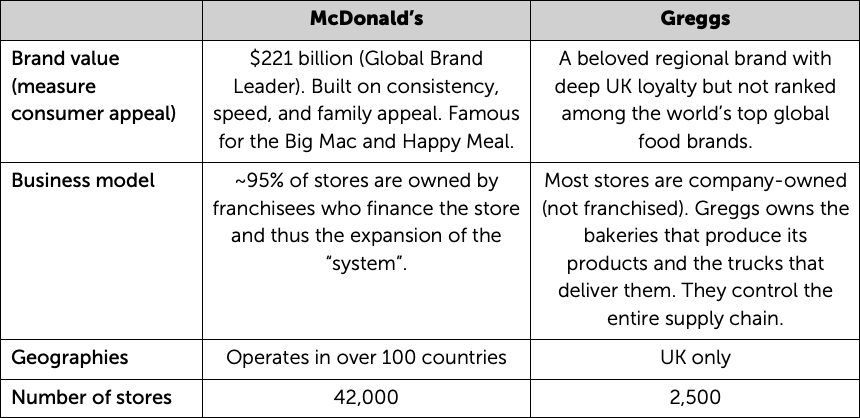
The scale of the difference is immediately apparent. McDonald’s Golden Arches are recognised in virtually every country on earth. They are trusted, wherever you travel, to deliver the same food at the same standard. That consistency — built over decades of franchise discipline — is one of the most valuable assets in the global food industry. Greggs, by contrast, is a purely domestic brand. Its strength lies in deep local loyalty, not international reach.

The financial gap is striking. McDonald’s generates more than three times Greggs’ entire annual revenue in free cash flow alone. The money McDonald’s has left over after paying all its operating costs exceeds what Greggs generates in total sales. McDonald’s market capitalisation is roughly 135 times that of Greggs. And McDonald’s largest market, the United States, is an economy growing faster than the UK and provides a structural tailwind that Greggs simply does not have.
This is not a reflection of Greggs being a poor business. It reflects what happens when a great business model — asset-light franchising, global brand power, and decades of operational compounding — is applied at scale in the world’s largest consumer markets.
Conclusion
At AXIAM, we look for companies that serve the most fundamental human needs and have proven, over years and decades, that they can do so profitably and consistently. Food is one of those needs. McDonald’s is one of those companies.
The McDonald’s story illustrates the AXIAM investing philosophy in full: identify a sector that will always be in demand, find a business within that sector that has built the strongest and most durable competitive advantages, and own it patiently over the long term. Scale, brand strength, cash generation, and global reach are not accidents of fortune. They are the result of decades of operational excellence.