
Introduction
Modern society cannot function without services enabled by data centres. They power virtually every digital service, whether you stream a movie, scroll through social media, search on Google, use ChatGPT or make an online purchase, you are connecting into a data centre somewhere. Businesses and governments cannot operate without ‘cloud computing services’ enabled by data centres.
In this article, we examine the growth and increasing importance of data centres that house computer chips powering artificial intelligence software (AI) and the impact on consumers, businesses and electricity demand.
Data Center Origins
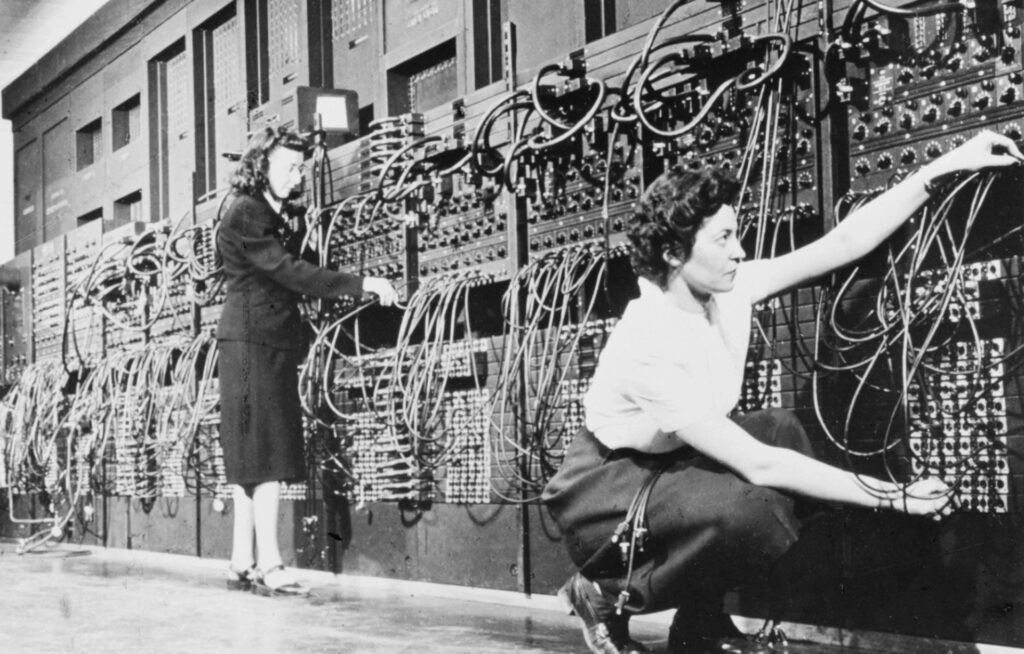
The story of data centres starts in 1946, a year after the end of WWII. The U.S. Army unveiled the Electronic Numerical Integrator and Computer (ENIAC), a hulking mainframe machine weighing 30 tons and drawing the about 150kW, the same amount of power as a small factory or roughly 100 000 homes. This machine filled a 45m wide “computer room” with a specially designed floor and cooling system.
By the late 1960s, the US government funded ARPANET project began connecting computing hubs, foreshadowing the distributed networks of today’s internet. The term “data centre” gained currency in the 1980s as businesses moved from isolated mainframes to clusters of minicomputers and servers networked throughout an organization. The microprocessor revolution led to an explosion of smaller computers called personal computers (PCs). Servers connected these individual PC’s together to create networks, and companies realized that housing servers in a single dedicated site – a data centre – was more secure and cost-effective than ad-hoc server closets scattered in office basements.
By the 1990s, with the rise of the internet, firms like Yahoo!, Amazon, and Google were building large “server farms” to handle booming website traffic.
The Cloud
A pivotal shift came in the mid-2000s with dedicated server farms morphing to cloud computing. In 2006, Amazon (under CEO Jeff Bezos) launched Amazon Web Services (AWS), renting out spare computing power from its own data centres to other businesses – effectively turning data centres into a utility service. Google and Microsoft soon followed, investing billions into global networks of hyperscale data centres – vast facilities each housing tens of thousands of servers.
Artificial Intelligence – AI
The artificial intelligence revolution has intensified data centre demand. The recent advances in generative AI, exemplified by OpenAI’s ChatGPT, require massive computing clusters filled with advanced semiconductors to process trillions of data points.
Each query to an AI model consumes significantly more electricity than traditional computing tasks. While estimates vary, recent analysis suggests each ChatGPT interaction uses roughly ten times the energy of a typical Google search, according to industry analysis. Multiplied across millions of AI queries and billions of daily internet interactions, data centres have earned the designation as “the factories of the Information Age.”
Modern Data Centres
Today, modern data centres operated by the “hyper scalers” (Google, META, Amazon and Microsoft) consume over 1 Gigawatt of electricity each, enough to power a city of over 750 000 homes. The largest datacentres consume the entire power output of a nuclear reactor!
Datacentres house thousands of server racks containing computer chips across hundreds of thousands of square meters of floor space. The computing power generates massive heat, requiring cooling systems that consume 30 to 50 percent of total power required to run a data centre. Water consumption reaches one to five million gallons daily, matching a small cities’ water usage.
US Data Centre Dominance
The growing usage of artificial intelligence is driving a need for even larger and more powerful data centres. Meeting the demands of modern AI applications requires not only vast amounts of computing power but also access to the most advanced semiconductor technology and expanded electricity supply. As a result, operators must continually increase data centre capacity to keep pace with the accelerating wave of AI innovation.
The United States commands overwhelming control of global data centre capacity. As of 2024, America hosts approximately 5,400 data centres—45% of the world’s total. Germany ranks second with 521 facilities, followed by the United Kingdom with 514.
Measured by actual computing capacity rather than facility count, American dominance becomes even more pronounced. The U.S. controls roughly 51% of total hyperscale data centre capacity worldwide, while China accounts for approximately 15% and the entire Europe/Middle East/Africa region combined holds under 20%.

Countries with the most data centres include the U.S. (45.6% share of total), Germany (4.4%), and the UK (4.4%).
This concentration grants American technology companies enormous leverage over global digital infrastructure. Three U.S. companies—Amazon, Microsoft, and Alphabet—together control over 60% of global hyperscale capacity, with Meta close behind. Each operates at least 60 data centres worldwide.
An estimated 70% of global internet traffic passes through Northern Virginia’s data centres alone, making the United States the de facto hub for worldwide cloud services and digital communications.
AI as a Commodity
Data centres represent modern infrastructure currently experiencing unprecedented attention due to artificial intelligence applications and the substantial capital investments flowing into both infrastructure and engineering talent. This pattern mirrors previous technology cycles. As with earlier infrastructure buildouts—from railroads to electricity grids to telecommunications networks—today’s cutting-edge technology will eventually mature into commodity services. It is already easy to switch between AI services like ChatGPT (OpenAI), Claude (Anthropic), Gemini (Google/Alphabet), Grok (Elon Musk’s Xai). It is not easy to stop using Microsoft and Apple.
Competitive Advantage in the AI Era
Companies with exceptional brands and deep customer loyalty have the option to use AI services in their businesses, but they will only pay for AI services if they provide business value. From supply chain optimization and customer service to product development and market analysis, artificial intelligence could become as fundamental to business operations as electricity became to manufacturing. We read our company financial statements and see AI referenced in pilot projects and experiments, but no evidence yet of significant cost reductions or revenue growth as a result of AI.
However, history suggests that once AI becomes ubiquitous—enabled by the massive data centre buildout currently underway—both the technology and supporting infrastructure will commoditize. Just as manufacturers no longer view access to electricity as a competitive differentiator, AI capabilities will eventually become table stakes rather than strategic advantages.
The infrastructure being built today may power tomorrow’s business transformation, but lasting advantage belongs to those companies who best serve their customers with desirable products and services they cannot live without, not those who merely deploy the most advanced technology.
Source
https://undetectable.ai/blog/how-much-energy-does-chatgpt-use/
https://www.visualcapitalist.com/ranked-the-top-25-countries-with-the-most-data-centers/