
Key Points.
The S&P 500, consisting of the 500 largest US companies, has become so concentrated that forty percent of its value sits, at the time of writing, in just ten companies. Those ten companies spend hundreds of billions on data centres to power AI services. They funded the build-out with cash they generate, then with borrowed money and now they are selling shares in their businesses.
- The ten largest companies in the S&P 500 now hold roughly 37% to 41% of the index’s total weight, up from 19% to 23% for most of the period between 1990 and 2015.
- Microsoft, Amazon, Alphabet, and Meta have guided to combined AI infrastructure spending of approximately $725 billion in 2026, a 77% increase over 2025.
- Rising capital expenditure has already reduced free cash flow at several of these companies: Alphabet reported a 47% year-on-year decline in the first quarter of 2026, and Amazon’s trailing free cash flow fell 95% over the same period.
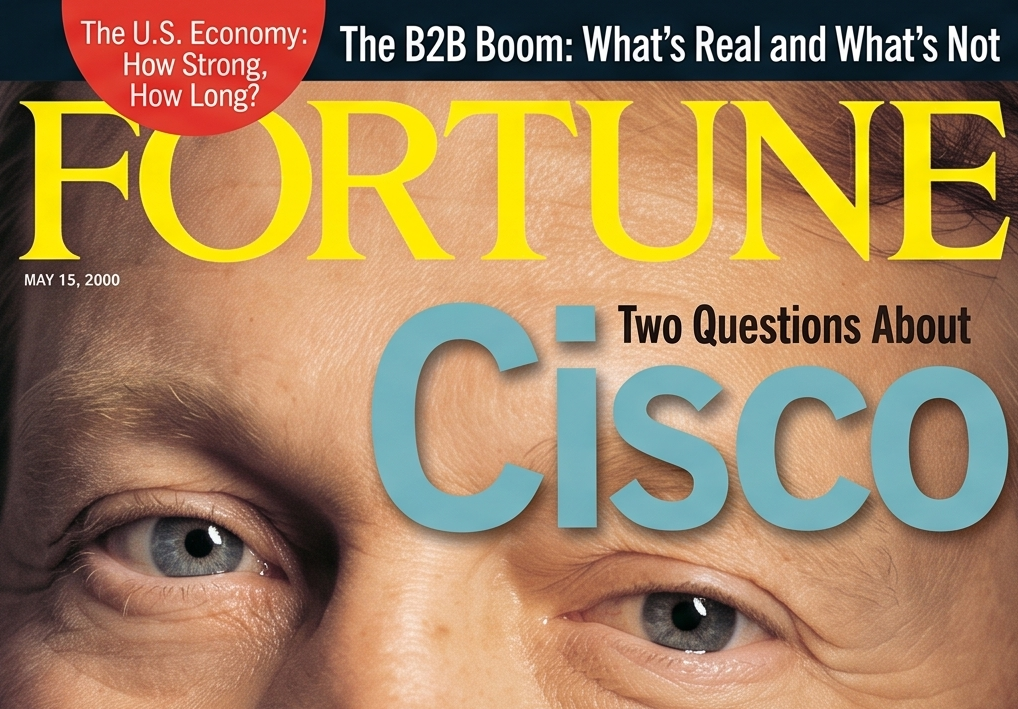
- A comparable concentration existed in 2000, when Cisco Systems briefly became the world’s most valuable company and the top ten S&P 500 holdings carried an outsized share of the index’s weight.
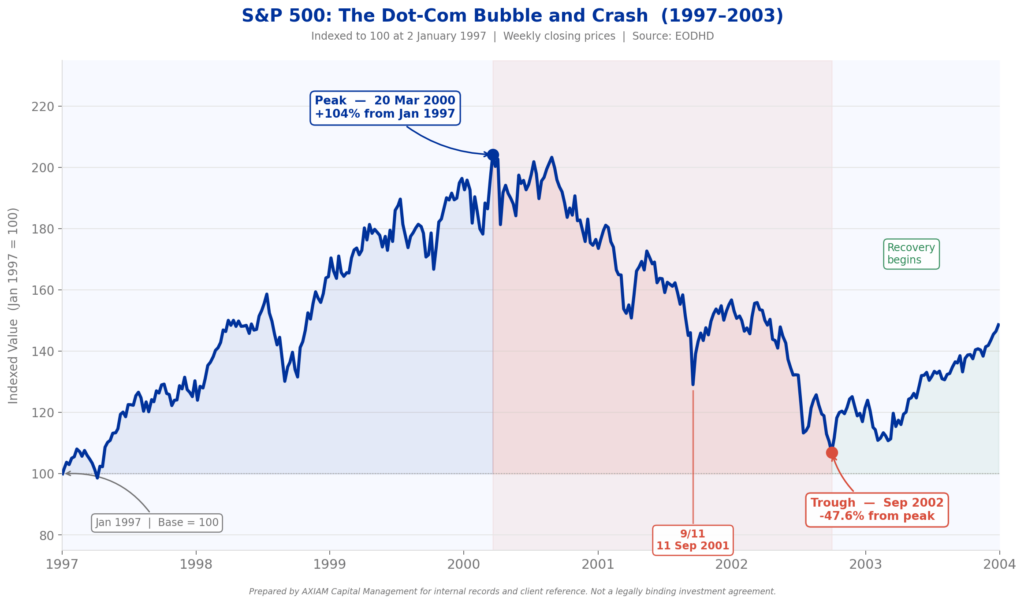
- During the correction that followed, the S&P 500 fell approximately 49% over two years.
- Berkshire Hathaway gained approximately 35.5% over the same period.
- At AXIAM, we manage portfolio risk with short-term treasuries.
- We own businesses that generate cash flow from consumers buying products and services essential for day to day living. Our companies do not depend on technology cycle outcomes.
The AI Capex Cycle
Microsoft, Amazon, Alphabet, and Meta fund their AI data centres primarily from cash generated by their existing businesses — cloud computing, advertising, and software. That internal cash has, until recently, been enough. Spending has accelerated, requiring these companies to borrow money in the corporate bond market to close the gap between what they earn and what they spend. Semiconductor companies like Nvidia, memory chip companies like Micron and a host of others providing networking, power, cooling and other related products and services depend on continued capital expenditure from this small group of customers. Combined capital expenditure across the four companies is projected at approximately $725 billion for 2026, up 77% from around $410 billion in 2025.
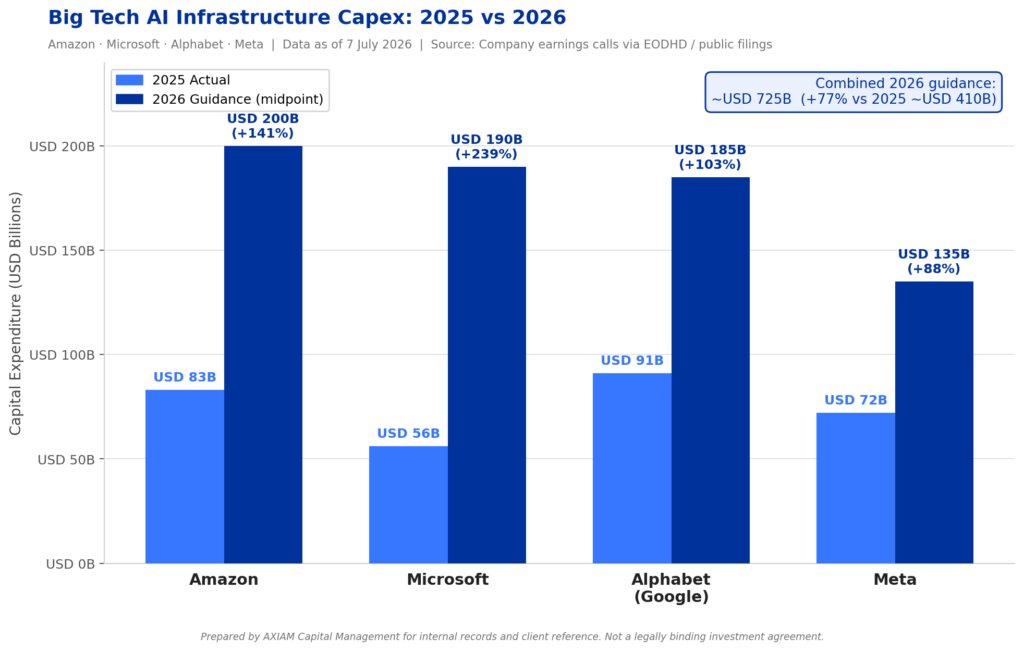
Free cash flow has declined: Alphabet reported a 47% year-on-year decline in the first quarter of 2026, and Amazon’s trailing free cash flow fell 95% over the same period.
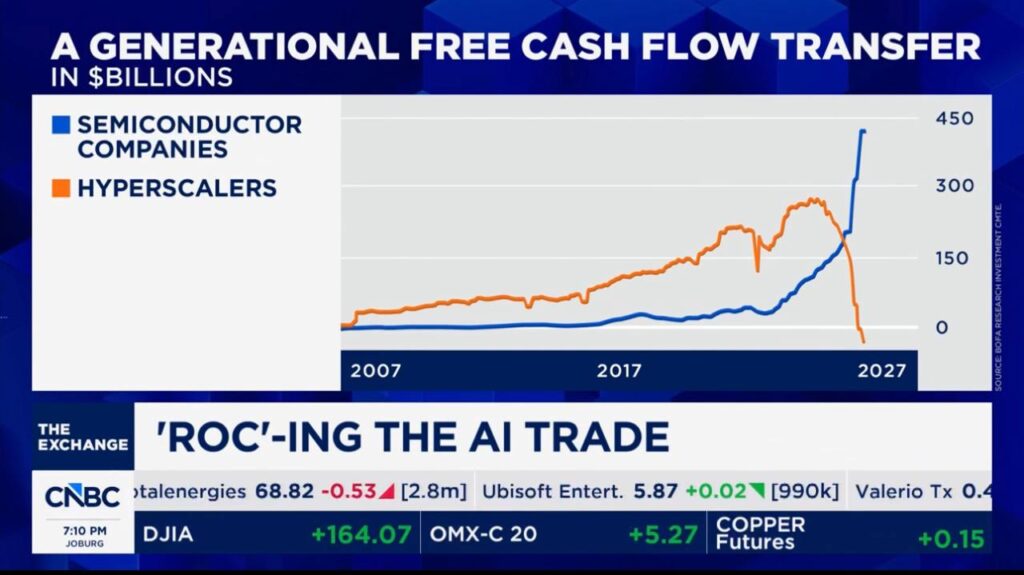
By May 2026, AI-related companies had raised approximately $236 billion in debt to help fund this spending, nearly four times the pace of the same period a year earlier.
Remembering 2000 Dot Com
In March 2000, Cisco Systems built the equipment carrying internet traffic and briefly became the most valuable business in the world, with a market value exceeding $500 billion. Over the following two years, Cisco’s share price fell 88%, from $80 to under $10, even as its revenue continued growing. The S&P 500 fell approximately 49% from its 2000 peak to its 2002 trough.
When these institutions move capital in concert, every currency on earth moves in the same direction simultaneously. It is not a coincidence, it is a trade.
Our companies in past market declines
Berkshire Hathaway gained approximately 35.5% over the same period, while Coca-Cola and Procter & Gamble kept their dividend in place, paying investors a growing income regardless of share price movements.

Managing Risk
In addition to purchasing indispensable businesses at a sensible price, portfolios with a cash and treasury buffer decline less when markets fall.
We wrote about portfolio risk management in a recent article (Click to Read).
“In a portfolio context, a short-term treasury holding serves a precise purpose. When equity markets are fairly valued or expensive, it provides risk mitigation against the “risk on” sentiment. It does not fall when sentiment changes. And when equity prices drop to levels that represent genuine value, we have the option to sell treasury holdings to buy great companies at low prices.”
Conclusion
At AXIAM, we hold businesses that produce something people already buy every day — food, beverages, and household goods among them. Their cash flow does not depend on continued spending in a single technology cycle. A correction concentrated in a small number of companies does not remove the case for owning the businesses outside that concentration. History suggests it strengthens it.