
We shared our views on the year ahead at our 2018 Annual client meeting. In particular, we provided an overview of the market indicators we are watching.
Market Indicator 1: The US 10 Year Long Bond Rate
As described in our Melt-up blog, economic growth and increased employment lead to more money available in the world economy. This increase in disposable income leads to increased purchases of consumer goods.
Low interest rates also result in increased borrowing as consumers and business alike take on more debt.
This increased demand for goods and services leads to an uptick in inflation.
The US Federal Reserve uses interest rates to control inflation. The market responds to the view of the US Federal Reserve and this is reflected in the US 10 Year rate. If inflation continues to rise interest rates are likely to be increased in order to slow inflation.
Increased interest rates lead to less consumption and less inflation over time. Rates also impact on the valuation of the market, not only as a result of reduced consumption, but also as a result of the increase in the denominator used to divide the cash flow of companies by, in determining the value of companies. The denominator is represented by the US 10 Year Rate as known as the ‘Risk Free Rate’.
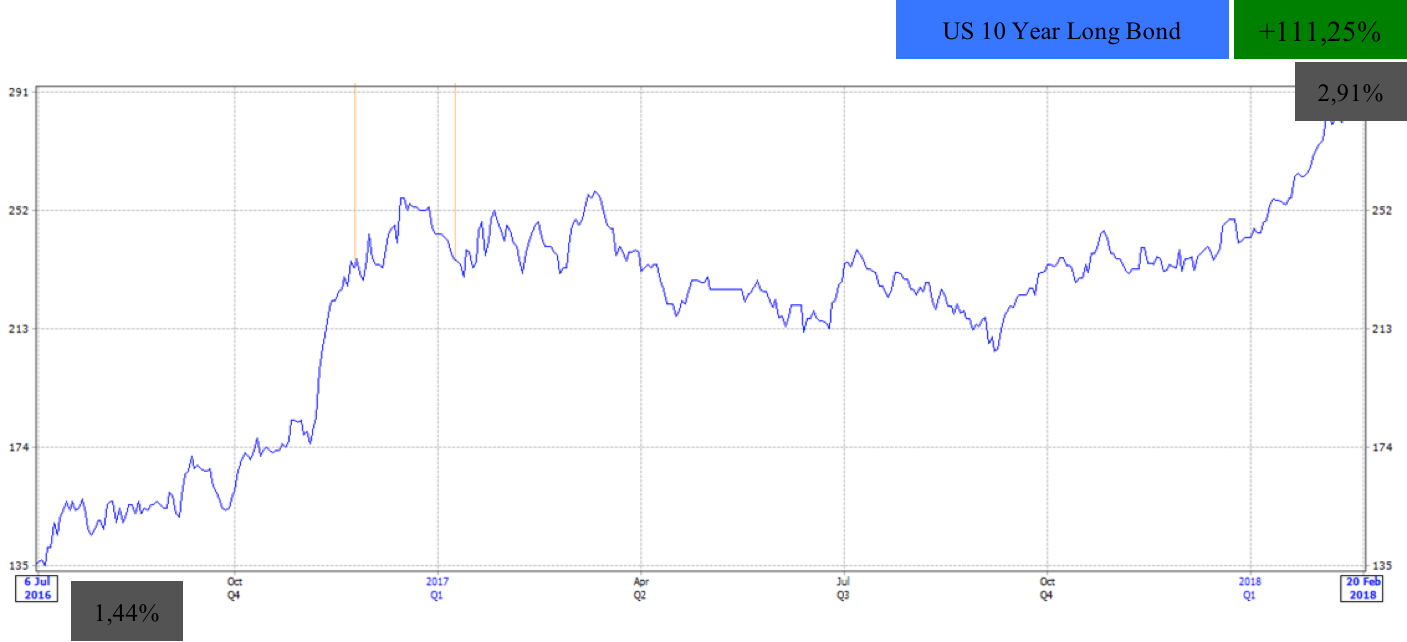
An increase in the US 10 Year Long Bond Rate beyond 3.5% often leads to a market downturn. Since July 2016 the bond rate has risen over 111% to 2.91%.
The increase in interest rates has a global impact and we use it as a buying opportunity when the downturn occurs.
US 10 Year Long Bond
Market Indicator 2 : The Oil Price
An increase in the oil price impacts the cost of goods. It takes a lot of oil to provide the basic resources, packaging and transport of most products.
Increasing oil prices come about from an increase in demand for products. In this way oil prices are a key determinant of inflation.
We saw the Brent Crude Oil price drop from $143.84 in 2008 to $27.88 in February 2016. Over the last two years we have seen the oil price slowly climb to $64.62 in January 2018. This increase reflects the increase in demand.
A counter to the increasing price of oil, could be an increased supply. The International Energy Agency (IEA) released a report that shows that the USA has become the largest oil producer in the world. The USA has also changed internal legislation so that it can become an exporter of oil.
Summary
The above two factors are an important determinant in the valuation of assets. Both are key ways to control inflation. Increases in both often lead to market downturns.
Despite any changes in the market we will focus on our 11 investment principles and look for opportunities to buy shares in companies that have strong brands, low debt equity ratios, produce cash and pay increasing dividends. Watching the markets will help us to buy those companies at the lowest possible prices and maximise investor wealth creation over the long term.
To find out more about our 11 principles of investing, how these market indicators are changing or how you could use timeless investing wisdom to grow wealth, sign up for our newsletter, follow us on Facebook or contact our fund managers.