
Introduction and Context
AXIAM invests in companies with the potential to sustain themselves for decades by avoiding obsolescence. History has repeatedly shown that technology companies are eventually replaced by newer innovations, sometimes rendering entire industries redundant. This article examines the longevity of companies that deliver on essential human needs compared to technology companies.
Coca-Cola was founded in 1886 to sell a simple syrup to soda fountain shops, where it was mixed with carbonated water to create a refreshing, non-alcoholic beverage. Today, Coca-Cola sells over 1.9 billion servings per day across 200 countries, most of which is still water. Procter & Gamble (P&G), established in 1837 by William Procter, a candle maker, and James Gamble, a soap maker, began by producing essential household products that remain indispensable today.
Railroads: The First Great Innovation
At the time of Coca-Cola’s founding, there were no technology companies in the modern sense. Instead, the most advanced industries were railroads, which were revolutionizing transportation. Companies like Union Pacific (founded 1862) and Pennsylvania Railroad (founded 1846) played a pivotal role in shaping economies. By 1900, Pennsylvania Railroad was the world’s largest company, transporting three times more freight than any other railroad.
Railroads were instrumental in expanding Coca-Cola and P&G beyond local sales, enabling nationwide distribution. However, by 1970, Pennsylvania Railroad collapsed after decades of decline, primarily due to the rise of automobiles and trucks, which eroded the dominance of rail transportation.
The Internal Combustion Engine: Transforming Distribution
The introduction of Henry Ford’s Model T in 1908 made automobiles widely accessible, fundamentally altering transportation, logistics, and consumer behaviour.
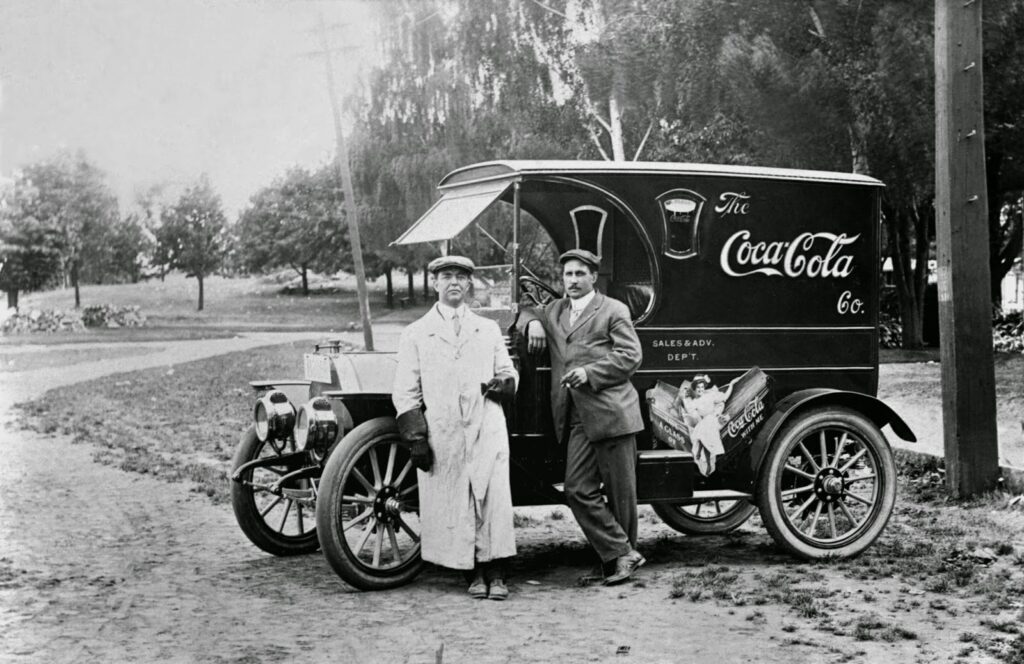
For Coca-Cola, the internal combustion engine transformed distribution. Initially sold as a fountain drink, Coca-Cola relied on local soda shops. However, as automobiles and trucks became commonplace, the company expanded far beyond railway towns and horse-drawn deliveries. By the 1920s, Coca-Cola had a nationwide distribution network, delivering bottled sodas to grocery stores, gas stations, and vending machines, all made possible by gasoline-powered trucks. This infrastructure shift allowed Coca-Cola to grow from a regional drink into a global brand.
For Procter & Gamble, the rise of automobiles allowed more efficient deliveries. Previously dependent on railroads, P&G leveraged trucks to reach smaller towns and rural areas, which lacked direct rail connections. This flexibility helped P&G expand its consumer base significantly.
The internal combustion engine also accelerated consumer culture, with roadside retail becoming a dominant force. Gas stations, supermarkets, and convenience stores became distribution hubs, allowing Coca-Cola and P&G’s products to be more accessible than ever before.
The Ford Motor Company avoided bankruptcy by securing private loans in 2006 after years of financial struggles. This allowed the company to restructure without a government bailout. General Motors and Chrysler were not so fortunate, and both filed for bankruptcy during the 2008 financial crisis.
In fact, since the first Model T Ford was introduced in 1908, thousands of motor companies worldwide have gone bankrupt. The automotive industry remains highly competitive, with many manufacturers failing due to financial struggles, poor sales, or technological advancements.
Communications & Logistics: From the Telegraph to the Telephone
The telegraph revolutionized long-distance communication in the 19th century, with Western Union (founded 1851) handling over 200 million messages annually by 1929.
However, the advent of the telephone (invented by Alexander Graham Bell in 1876) rendered the telegraph obsolete. Western Union ultimately ceased its telegraph services in 2006, marking the end of an era.
For Coca-Cola and P&G, telecommunications enhanced logistics, supplier coordination, and distribution efficiency. What began as telegraph-based communication evolved into the telephone, radio, and digital marketing, allowing these consumer goods giants to streamline operations and expand their reach.
Consumer Communications: Mass Marketing through Radio and Television
Coca-Cola’s ability to mass-produce bottled beverages helped it scale rapidly. By the early 20th century, advertising and branding—through printed posters and newspaper ads—solidified Coca-Cola’s dominance.
The arrival of radio in the 1920s created a new form of mass communication. RCA (Radio Corporation of America, founded 1919) became a broadcasting giant, providing companies like P&G and Coca-Cola with an advertising platform. P&G pioneered radio and television sponsorship, funding soap operas—a genre
named after its soap brand sponsorships.
However, as television and FM radio gained popularity, RCA failed to adapt. By 1986, General Electric acquired RCA, marking its decline, while Coca-Cola and P&G seamlessly transitioned their advertising efforts to television. Today they have surpassed television spend and are dominant spenders in social media.
Modern Computing: The Rise and Fall of Tech Giants
After World War II, the modern computing industry was born, with IBM dominating mainframes. However, early competitors like Burroughs, Univac, NCR, and Honeywell eventually disappeared or were absorbed into larger firms.
Coca-Cola and P&G invested in early mainframe computing in the 1950s and 1960s to enhance supply chain management, payroll, and logistics. P&G used IBM mainframes for inventory management, while Coca-Cola optimized sales tracking and accounting.
The Personal Computer Boom and the Internet Revolution
The rise of personal computing in the 1970s and 1980s created new industry leaders. However, many failed to sustain their dominance. Osborne Computer (1981) pioneered portable computers but went bankrupt by 1983. Commodore (once a home computing leader) collapsed in 1994 after 36 years in business. Atari, dominant in gaming, was broken up and lost relevance after approximately 12 years.
The dot-com boom of the 1990s saw companies like Netscape, AOL, and Yahoo! dominate early internet markets. Yet, Microsoft crushed Netscape after 5 years, AOL became obsolete after 17 years with broadband, and Yahoo! failed to compete with Google, leading to its 2017 sale to Verizon after 23 years in business.
Meanwhile, Coca-Cola and P&G used the internet to their advantage, launching e-commerce and digital marketing. They leveraged real-time data to optimize logistics, reducing inefficiencies and maximizing distribution.
Why Great Companies Endure While Tech Companies Fade
Through economic depressions, world wars, and multiple technological disruptions, Coca-Cola and P&G have remained relevant for 139 and 188 years respectively. They have thrived for over a century, continuously adapting to new distribution models, marketing channels, and consumer preferences while remaining fundamentally unchanged in their core business: delivering essential human needs.
Technology companies, on the other hand, are inherently more volatile. Many rise to dominance only to fade into irrelevance, get acquired, or collapse entirely. Even companies that have dominated industries for decades—such as Intel, Sun Microsystems, and BlackBerry—have been overtaken by newer innovations. The nature of technology is disruptive, and few firms can sustain themselves for long periods.
Conclusion: The Case for Investing in Longevity
History has repeatedly shown that while technology evolves and disrupts itself, consumer staples endure. Coca-Cola and P&G have successfully integrated every technological advancement into their operations, using them to enhance logistics, marketing, and global distribution rather than being made obsolete by them.
While the AI revolution may shape the next era of technological disruption, history suggests that many of today’s leading tech companies will eventually be replaced—just like railroads, telegraphs, radio giants, and dot-com pioneers before them. Meanwhile, Coca-Cola will still be selling sodas and water, and P&G will still be making soap, just as they have for over a century.
Sources
- Coca-Cola sells 1.9 billion servings daily across 200+ countries
https://www.coca-colacompany.com/about-us - Procter & Gamble was founded in 1837 by William Procter and James Gamble
https://www.britannica.com/topic/Procter-and-Gamble-Company - Pennsylvania Railroad was the world’s largest company in 1900
https://www.american-rails.com/pennsylvania-railroad.html - Henry Ford introduced the Model T in 1908
https://www.ford.com/about/history/ - Western Union was founded in 1851 and dominated telegraph services
https://www.history.com/topics/inventions/telegraph - RCA was founded in 1919 and became a broadcasting giant
https://www.britannica.com/topic/Radio-Corporation-of-America - IBM led the mainframe revolution post-World War II
https://www.ibm.com/history - Osborne Computer Corporation pioneered portable computers in 1981, declared bankruptcy in 1983
https://www.computerhistory.org/brochures/osborne-computer-corporation/ - Commodore International filed for bankruptcy on April 29, 1994
https://en.wikipedia.org/wiki/Commodore_International#Sale_to_Escom_and_bankruptcy - Atari lost market relevance in the mid-1980s
https://www.theguardian.com/business/2013/jan/21/atari-files-bankruptcy-america - Netscape was acquired by AOL in 1999
https://www.wsj.com/articles/SB921707787528132061 - AOL was acquired by Verizon in 2015
https://www.verizon.com/about/news/verizon-acquire-aol - Yahoo! was acquired by Verizon in 2017
https://www.forbes.com/sites/briansolomon/2016/07/25/yahoo-sells-to-verizon-for-5-billion-marissa-mayer/